WJ

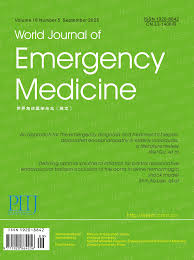
World Journal Of Emergency Medicine

World Journal of Emergency Medicine (ISSN 1920-8642) is an open access, bimonthly journal featuring content in emergency medicine. The journal presents a range of article formats, including review articles, original articles, research letters, viewpoints, and case letters, and reports an impact factor of 3.2 (Q1). Chief Editor: Jian-an Wang (Hangzhou).

Looking to publish in World Journal Of Emergency Medicine? Livewrite integrates seamlessly with Word to help you write, edit, and format faster.

Try Livewrite for free
Subject Emergency Medicine
Impact Factor 3.2
Quartile Q1
Open Access Type Open
ISSN 1920-8642
eISSN 1920-8642
Invitation Only No

Submission Instructions

World Journal Of Emergency Medicine accepts the following article types. Click on an article type to view submission instructions.

Original Article

Cover Letter A cover letter is required and must confirm exclusive submission, lack of prior publication, author approval, and disclosure of conflicts. You may also explain the study’s significance and suggest reviewers; identify the corresponding author.
Title Page Include a title page at the front of the manuscript with the full title, all author names and affiliations, corresponding author contact details (address, phone, fax, email), and the total word count.
Abstract Provide a structured abstract (maximum 250 words) with Background, Methods, Results, and Conclusions, followed by 3–6 MeSH keywords.
Main Manuscript Headings Follow an IMRaD structure: Introduction, Methods (design, setting, participants, interventions, outcomes, analysis), Results, Discussion (context and limitations), and a one‑paragraph Conclusions section.
Reference Format Use numerical superscript citations in order of appearance; list references numerically with journal names abbreviated per PubMed, listing up to 6 authors, otherwise first 6 plus “et al.”
Figures Upload figures as separate, high‑resolution files and cite them in sequence within the text; include permissions for identifiable patients or previously published material.
Tables Create each table on a separate, double‑spaced page with a title, column headings, and explanatory legends; number tables consecutively as cited.
Additional Documents Include IRB/ethics approval and informed consent statements when applicable, clinical trial registration number for trials, a signed conflict of interest disclosure for all authors, and an author contributions statement.
Reformat to World Journal Of Emergency Medicine using Livewrite Premium

Review Article

Cover Letter A cover letter is required confirming exclusivity, prior publication status, author approvals, and conflicts; you may outline the review’s relevance and propose reviewers. If unsolicited, consider contacting the Editor with an outline before submission.
Title Page Begin with a title page listing the manuscript title, all authors and affiliations, corresponding author contact information, and the word count.
Abstract An abstract (maximum 250 words) is required. Systematic reviews/meta‑analyses should use a structured abstract with Background, Data resources, Results, and Conclusions; narrative reviews may use an unstructured abstract.
Main Manuscript Headings No fixed structure is mandated; organize sections appropriate to the topic. Systematic reviews should clearly describe data sources, selection criteria, synthesis methods, and key findings.
Reference Format Cite using superscript numbers in order; list references numerically with PubMed‑style journal abbreviations, listing up to 6 authors, otherwise first 6 plus “et al.”
Figures Upload any figures as separate, high‑resolution files and cite them where discussed in the text.
Tables Provide each table on its own double‑spaced page with a title, headings, and explanatory notes; number sequentially.
Additional Documents Submit signed conflict of interest disclosures for all authors and an author contributions statement. If applicable, include statements regarding permissions for reproduced material.
Reformat to World Journal Of Emergency Medicine using Livewrite Premium

Research Letter

Cover Letter A cover letter is required confirming exclusive submission, prior publication status, author approvals, and conflicts; you may briefly highlight the preliminary nature and significance of the findings.
Title Page Provide a title page with the title, all authors and affiliations, corresponding author contact details, and word count.
Abstract Abstracts are not required for Research Letters.
Main Manuscript Headings No fixed structure is mandated; present a concise narrative of background, approach, key observations/results, and brief discussion as appropriate.
Reference Format Use superscript numbers in order of citation with a numerically ordered reference list; follow PubMed abbreviation and author listing rules.
Figures Upload up to two figures as separate, high‑resolution files and cite them in order in the text.
Tables Upload tables on separate pages if included (maximum two total tables/figures); number sequentially with titles and legends.
Additional Documents If patient information is included, indicate informed consent within the manuscript and provide documentation as required; include conflict of interest disclosures and an author contributions statement.
Reformat to World Journal Of Emergency Medicine using Livewrite Premium

Editorial

Cover Letter Include a cover letter confirming exclusivity, prior publication status, author approvals, and conflicts; briefly state the editorial’s relevance.
Title Page Start with a title page listing the title, authors and affiliations, corresponding author contact information, and word count.
Abstract Abstracts are not specified for Editorials and are generally not required.
Main Manuscript Headings No prescribed headings; organize the commentary logically to frame the issue, present viewpoints, and conclude.
Reference Format Cite references with superscript numbers in order and list them numerically with PubMed‑style abbreviations.
Figures If including figures, upload them as separate files and cite them in the text.
Tables If including tables, place each on a separate page with a title and legend, numbered sequentially.
Additional Documents Provide conflict of interest disclosures for all authors and an author contributions statement as applicable.
Reformat to World Journal Of Emergency Medicine using Livewrite Premium

Letter to the Editor

Cover Letter A cover letter is required for all submissions; it must identify the corresponding author (with email), disclose any conflicts of interest and financial relationships, specify each author's contribution, confirm all coauthors have approved the submission, and state that the work is not under consideration or previously published elsewhere.
Abstract Abstracts are not required for Letters to the Editor.
Manuscript No specific section structure or word limit is specified for Letters to the Editor.
References Format references in Vancouver style using numerical superscript citations in order of appearance, abbreviate journal names per PubMed, list all authors up to 6 then use “et al.”, and note that no maximum reference count is indicated.
Figures & Tables Figures must be submitted as individual, high‑resolution files on separate pages with separate legends, and tables must be typed double‑spaced each on a separate sheet; no maximum number of figures or tables is indicated.
Reformat to World Journal Of Emergency Medicine using Livewrite Premium

Recent Publications

A case report of brain abscess caused by Nocardia cyriacigeorgica identified by metagenomic next-generation sequencing

Wenqing Tu

10.5847/wjem.j.1920-8642.2026.019
View Publication

Multidisciplinary collaborative management of vertebral artery dissection in a young male: a case report

Huan Zhang

10.5847/wjem.j.1920-8642.2026.017
View Publication

Gastric volvulus: a rare but potentially fatal mimicker of gastroenteritis -- a case report

Alston Guan Jie Ong

10.5847/wjem.j.1920-8642.2026.016
View Publication

The utility of the trans-splenic retrocardiac view in supine critically ill patients

Issac Cheong

10.5847/wjem.j.1920-8642.2026.018
View Publication

Prediction model for quality of life in sepsis survivors one year after discharge

Yi Yao

10.5847/wjem.j.1920-8642.2026.015
View Publication

Frequently asked questions

Is World Journal Of Emergency Medicine open access?

Yes, World Journal Of Emergency Medicine is a fully open access journal. All articles are freely available to read, download, and share immediately upon publication.

Reformat to World Journal Of Emergency Medicine using Livewrite Premium

What is the impact factor of World Journal Of Emergency Medicine?

The 2024 Journal Impact Factor (JIF) for World Journal Of Emergency Medicine is 3.2. The impact factor is a measure of the frequency with which the average article in a journal has been cited in a particular year, and is often used as a proxy for the relative importance of a journal within its field.

Reformat to World Journal Of Emergency Medicine using Livewrite Premium

What is the time to publication for World Journal Of Emergency Medicine?

Manuscripts undergo initial editorial screening followed by double‑blind peer review by two or more experts. Page proofs are sent to the corresponding author and should be returned within seven days. Accepted papers are posted online as 'Just Accepted' immediately upon acceptance to expedite dissemination.

Reformat to World Journal Of Emergency Medicine using Livewrite Premium

Does World Journal Of Emergency Medicine require a cover letter?

Yes. A cover letter is required for all submissions and must confirm that the manuscript is not under consideration elsewhere, that none of its contents have been published, that all authors have read and approved the submission, and that any conflicts of interest are fully disclosed (or that none exist). Authors may also explain the importance of the work, suggest reviewers to include or avoid, and must identify the corresponding author.

Reformat to World Journal Of Emergency Medicine using Livewrite Premium

Research Topics

Cardiac Arrest and Resuscitation Sepsis Diagnosis and Treatment Emergency and Acute Care Studies Trauma and Emergency Care Studies Respiratory Support and Mechanisms