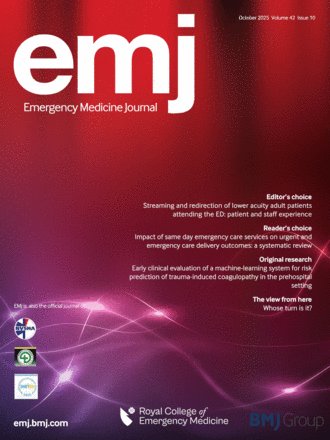
EM

Emergency Medicine Journal

Emergency Medicine Journal is an international, peer‑reviewed journal covering pre‑hospital and hospital emergency medicine and critical care. It publishes original research, evidence‑based reviews and commentaries across topics such as resuscitation, trauma, minor injuries, disaster preparedness and response, toxicology, acute medical and paediatric emergencies, diagnostic testing, teaching, clinical operations, decision making and reflections on clinical practice. The journal’s audience includes doctors, nurses, paramedics and ambulance staff.

Looking to publish in Emergency Medicine Journal? Livewrite integrates seamlessly with Word to help you write, edit, and format faster.

Try Livewrite for free
Subject Emergency Medicine
Impact Factor 2.7
Quartile Q1
Open Access Type Hybrid
ISSN 1472-0205
eISSN 1472-0213
Invitation Only No
Cost Range Optional open access APC: £4,370 (excl. VAT); optional print colour: £485; no submission, page, or online-only colour figure charges

Submission Instructions

Emergency Medicine Journal accepts the following article types. Click on an article type to view submission instructions.

Original Research

Cover Letter A cover letter is not universally required; however, if your study’s methodology does not have a suitable reporting checklist, explain in the cover letter why no checklist is attached.
Title Page Include a cover page with the manuscript word count for all submissions. Standard title page details (title, authors, affiliations, corresponding author) should be provided per journal submission system requirements.
Abstract A structured abstract of up to 300 words is required with Background, Methods, Results, and Conclusion. Randomized trials must also adhere to CONSORT abstract guidance.
Key Points Provide a ‘Key messages’ box after the abstract with three headings: What is already known on this topic; What this study adds; How this study might affect research, practice or policy (3–5 succinct sentences).
Main Manuscript Headings Follow a standard IMRaD structure: Introduction, Methods, Results, and Discussion. Conclusions should be included at the end of the Discussion rather than as a separate section.
Figures Provide figures as separate supplementary files; ensure they are clearly labeled and cited in the text in sequence.
Tables Place tables within the main manuscript text at the point where they are first cited and number them sequentially.
Additional Documents Upload the appropriate EQUATOR reporting checklist labeled “Research Checklist,” include a Data Availability Statement, provide trial registration details where applicable, and add the required Patient and Public Involvement statement.
Reformat to Emergency Medicine Journal using Livewrite Premium

Systematic Review

Cover Letter A cover letter is expected to outline the question and synthesis approach, and note any non‑preferred reviewers with reasons.
Title Page Provide a cover page with the manuscript word count.
Abstract A structured abstract is required; ensure it aligns with PRISMA reporting where applicable.
Key Points Include a ‘Key messages’ box after the abstract with the three required headings (3–5 sentences).
Main Manuscript Headings Use standard sections for systematic reviews (Introduction, Methods, Results, Discussion) and report per PRISMA, including search strategy, selection process, and risk of bias.
Figures Upload figures as separate files; up to six figures/tables are allowed.
Tables Up to six tables are permitted; number and cite them in sequence. Include a PRISMA flow diagram as appropriate.
Additional Documents Submit a completed PRISMA checklist; provide an online appendix with exact search terms; include PROSPERO registration details if available; add a Data Availability Statement.
Reformat to Emergency Medicine Journal using Livewrite Premium

Editorial

Cover Letter A brief cover letter may be included to outline the proposed editorial topic or context.
Title Page Include a cover page with the manuscript word count if submitting a proposal or draft for consideration.
Abstract No abstract requirements are specified for editorials.
Main Manuscript Headings No specific structure required; present a concise argument or perspective on the topic.
Figures Figures, if used, are at editorial discretion and should be uploaded per system instructions.
Tables Tables, if used, are at editorial discretion and should be placed appropriately or uploaded per instructions.
Reformat to Emergency Medicine Journal using Livewrite Premium

Commentary

Cover Letter A brief cover letter is expected to introduce the commentary’s purpose and any relevant context.
Title Page Include a cover page with the manuscript word count if submitting by invitation.
Abstract No abstract requirements are specified for commentaries.
Main Manuscript Headings No mandated structure; align content with the focal article and objectives set by the editors.
Figures If included, limit to one figure; upload separately as needed for review.
Tables If included, limit to one table and place appropriately.
Reformat to Emergency Medicine Journal using Livewrite Premium

Recent Publications

What factors delay initiation of bystander CPR in out-of-hospital cardiac arrest? Results from an analysis of 200 recorded ambulance calls

Barbara Farquharson, Marie Johnston, Catherine Best, Gareth R Clegg

10.1136/emermed-2024-214733
View Publication

Preoxygenation in prehospital critical care: a survey of HEMS practices in eight European countries

Simon Rauch, Urs Pietsch, Giulia Roveri

10.1136/emermed-2025-215335
View Publication

Research priorities for paediatric procedural sedation in emergency medicine

Daniel S Tsze, Rebecca K Burger, Eileen J Klein, Todd P Chang, Keli D Coleman, Alexander J Rogers, Carmen D Sulton, Corrie E Chumpitazi, Emine M Tunc, Amy L Drendel

10.1136/emermed-2025-215575
View Publication

Could the EmPATH model help redesign mental healthcare in UK emergency departments?

Henry Vardon, Jane Grassie, Rajendra Raman, Scott Zeller

10.1136/emermed-2025-215036
View Publication

Tea trolley training: a novel approach to prehospital teaching

Ian Sheldrake, Matthew Kerton

10.1136/emermed-2025-215826
View Publication

Frequently asked questions

Is Emergency Medicine Journal open access?

Emergency Medicine Journal is a hybrid journal, offering both traditional subscription-based publishing and open access options. Authors can choose to make their articles open access by paying an Article Processing Charge (APC).

Reformat to Emergency Medicine Journal using Livewrite Premium

What is the impact factor of Emergency Medicine Journal?

The 2024 Journal Impact Factor (JIF) for Emergency Medicine Journal is 2.7. The impact factor is a measure of the frequency with which the average article in a journal has been cited in a particular year, and is often used as a proxy for the relative importance of a journal within its field.

Reformat to Emergency Medicine Journal using Livewrite Premium

What is the time to publication for Emergency Medicine Journal?

Median time to first decision with review is 77 days; median time to first decision without review is 4 days; median time from acceptance to publication is 19 days.

Reformat to Emergency Medicine Journal using Livewrite Premium

Does Emergency Medicine Journal require a cover letter?

Cover letters are mentioned in relation to reporting guidelines: if no suitable research checklist exists for your study design, explain in the cover letter why no checklist is attached. No additional cover letter requirements are detailed.

Reformat to Emergency Medicine Journal using Livewrite Premium

How much does it cost to publish in Emergency Medicine Journal?

The journal operates on a subscription model with an optional hybrid open access route. Specific APC amounts or other author charges are not provided on this page.

Reformat to Emergency Medicine Journal using Livewrite Premium

Research Topics

Emergency and Acute Care Studies Trauma and Emergency Care Studies Cardiac Arrest and Resuscitation Trauma Management and Diagnosis Disaster Response and Management