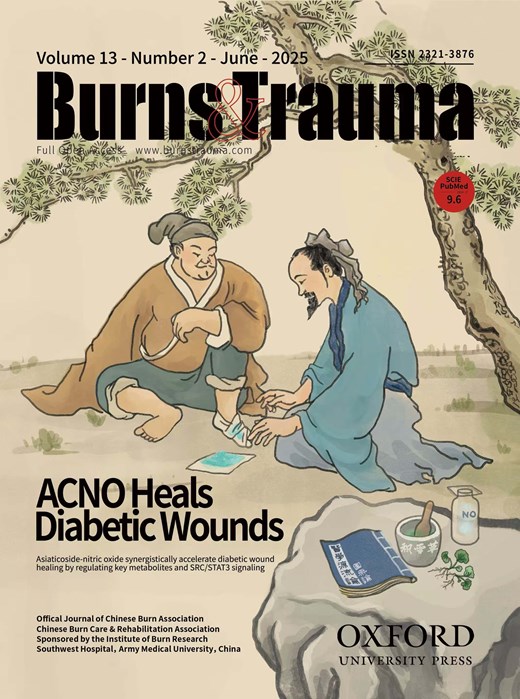
B&

Burns & Trauma

Burns & Trauma highlights research and expert perspectives across burns and trauma care, with emphasis on wound healing and regeneration, scar biology and management, biomaterials and skin substitutes, autophagy and lysosome biology in injury, sepsis and haemodynamic management, microbiome influences on recovery, and skin tissue engineering. The journal features thematic series and special issues that bring together cutting‑edge research and comprehensive reviews to advance clinical practice and translational science in the field.

Looking to publish in Burns & Trauma? Livewrite integrates seamlessly with Word to help you write, edit, and format faster.

Try Livewrite for free
Subject Dermatology, Emergency Medicine , Surgery
Impact Factor 9.6
Quartile Q1
Open Access Type Open
ISSN 2321-3868
eISSN 2321-3876
Invitation Only No
Cost Range $2,800 APC (CC BY or CC BY-NC)

Submission Instructions

Burns & Trauma accepts the following article types. Click on an article type to view submission instructions.

Research

Cover Letter Cover letters are not explicitly required, but if provided, disclose any use of AI tools in the study. The page does not specify additional cover letter content.
Title Page Upload a separate title page listing all authors, affiliations, acknowledgements, and corresponding author contact information to support double‑blind review.
Abstract A structured abstract of up to 350 words is required.
Key Points Provide 3–5 ‘Highlights’ bullet points that summarize novel results and methods; submit as a separate file clearly named ‘Highlights’.
Main Manuscript Headings Follow IMRaD: Background, Methods, Results, Discussion, and Conclusion.
Reference Format References may be in any readable style at submission. The journal follows Oxford SCIMED style and UK spelling for final publications; include data/software citations where applicable.
Figures Upload figures as separate high‑quality files with legends and number them consecutively (acceptable formats include pdf, eps, gif, tif, jpg).
Additional Documents Include a Declarations section (ethics approval, consent, data availability, conflicts, funding, author contributions, acknowledgements). Provide patient consent documentation if identifiable data are used; disclose AI use; obtain permissions for third‑party material. ORCID for the submitting author is required.
Reformat to Burns & Trauma using Livewrite Premium

Review

Cover Letter Cover letters are not explicitly required; if included, disclose any use of AI tools. No additional specifics are provided.
Title Page Provide a separate title page with authors, affiliations, acknowledgements, and corresponding author contact details.
Abstract An unstructured abstract of up to 350 words is required.
Key Points Submit 3–5 ‘Highlights’ bullet points in a separate file to summarize key insights.
Main Manuscript Headings Use Background, Review, and Conclusions, organizing content with informative section and subsection headings as needed.
Reference Format Any readable style at submission; final articles follow Oxford SCIMED style and UK spelling. Include data/software citations if relevant.
Figures Upload figures as separate files with legends and consecutive numbering.
Tables Not specified. The system will combine all uploaded files into a single PDF for peer review.
Additional Documents Provide the full Declarations section. Include permissions for third‑party content as needed; disclose any conflicts, funding, and AI use; ensure ORCID for the submitting author.
Reformat to Burns & Trauma using Livewrite Premium

Editorial

Cover Letter Not specified as required; include a cover letter only if desired, and disclose any AI use if applicable.
Title Page Provide a separate title page with authors, affiliations, acknowledgements, and corresponding author information.
Abstract Abstracts are not required for Editorials.
Key Points Highlights are optional; if provided, include 3–5 bullet points in a separate file.
Main Manuscript Headings Organize with informative section/subsection headings as appropriate.
Reference Format Any readable style at submission; conform to Oxford SCIMED style and UK spelling for final publication.
Figures Upload figures as separate files with legends and sequential numbering, if used.
Tables Not specified; the submission system will combine uploaded files into a single PDF for peer review.
Additional Documents Include the Declarations section and any relevant permissions; state conflicts, funding, and any AI use; ORCID required for the submitting author.
Reformat to Burns & Trauma using Livewrite Premium

Letter to the Editor

Cover Letter Not specified as required. If included, disclose any AI use in the cover letter per policy.
Title Page Upload a separate title page with author names, affiliations, acknowledgements, and corresponding author contact information.
Abstract Abstracts are not required for Letters to the Editor.
Key Points Highlights are not required for this article type.
Main Manuscript Headings Organize the letter with clear headings as needed; keep within 1200 words and 5 references.
Reference Format Use any readable style at submission; ensure accuracy. Final formatting follows Oxford SCIMED style.
Figures If figures are included, upload as separate files with legends and consecutive numbering.
Additional Documents Include the Declarations section as applicable; provide permissions for any third‑party material; disclose conflicts/funding and any AI use; ORCID required for the submitting author.
Reformat to Burns & Trauma using Livewrite Premium

Guideline

Cover Letter Not explicitly required. If you submit a cover letter, disclose any use of AI tools per policy.
Title Page Upload a separate title page with authors, affiliations, acknowledgements, and corresponding author contact information.
Abstract An unstructured abstract of up to 350 words is required.
Key Points Provide 3–5 ‘Highlights’ bullet points as a separate file to emphasize key recommendations.
Main Manuscript Headings Organize with clear section and subsection headings using short, informative titles.
Reference Format Any readable style at submission; the journal follows Oxford SCIMED style and UK spelling for final formatting.
Figures Provide figures as separate files with legends; number consecutively.
Tables Not specified; uploaded files will be merged into a single PDF for peer review.
Additional Documents Include Declarations (ethics, consent, data availability, conflicts, funding, author contributions, acknowledgements). Provide permissions for third‑party material and disclose AI use if applicable; ORCID required for the submitting author.
Reformat to Burns & Trauma using Livewrite Premium

Recent Publications

Current progress of skin tissue engineering: Seed cells, bioscaffolds, and construction strategies

Yan Jin, Huanjing Bi

10.4103/2321-3868.118928
View Publication

Characteristics of burn deaths from 2003 to 2009 in a burn center: A retrospective study

Hong Yan, Jiaping Zhang, Zhiqiang Yuan, Jun Wu, Jian Chen, Gaoxing Luo, Qizhi Luo, Xiaolu Li, Daizhi Peng, Yizhi Peng, Jianian Hu

10.4103/2321-3868.118933
View Publication

Mitsugumin 53 protects the kidney from severe burn injury in mice

Gaoxing Luo, Jun Wu, Yanjun Wu, Jian Huang, Daisong Liu, Jianglin Tan, Yanmeng Peng, Junjie Yang, Yanyan Cui, Weifeng He

10.4103/2321-3868.123074
View Publication

Exercise behaviors and barriers to exercise in adult burn survivors: A questionnaire survey

Frank Li, Jennifer Baldwin

10.4103/2321-3868.123075
View Publication

Staged management of giant traumatic abdominal wall defect: A rare case report

Sanchit Jain, LaxmiNarayan Meena, Somendra Bansal

10.4103/2321-3868.123077
View Publication

Frequently asked questions

Is Burns & Trauma open access?

Yes, Burns & Trauma is a fully open access journal. All articles are freely available to read, download, and share immediately upon publication.

Reformat to Burns & Trauma using Livewrite Premium

What is the impact factor of Burns & Trauma?

The 2024 Journal Impact Factor (JIF) for Burns & Trauma is 9.6. The impact factor is a measure of the frequency with which the average article in a journal has been cited in a particular year, and is often used as a proxy for the relative importance of a journal within its field.

Reformat to Burns & Trauma using Livewrite Premium

What is the time to publication for Burns & Trauma?

The journal reports 31 days to first decision for all manuscripts and 40 days to first decision for reviewed manuscripts only. The average time from submission to acceptance is 123 days, and acceptance to publication is 35 days. The editorial office also notes an average six weeks from submission to first decision in the peer review section.

Reformat to Burns & Trauma using Livewrite Premium

Does Burns & Trauma require a cover letter?

Cover letters are mentioned but not explicitly required. If a cover letter is submitted, authors should disclose any use of AI tools in generating content, images, code, or translations. No other specific cover letter contents are detailed.

Reformat to Burns & Trauma using Livewrite Premium

How much does it cost to publish in Burns & Trauma?

Burns & Trauma is fully open access. An Article Processing Charge (APC) of $2,800 applies for publication under CC BY or CC BY‑NC licenses, payable upon acceptance. Waivers or discounts may be available for corresponding authors based in low and middle income countries. Authors affiliated with institutions under Read and Publish agreements may have APCs covered by their institution.

Reformat to Burns & Trauma using Livewrite Premium

Research Topics

Wound Healing and Treatments Burn Injury Management and Outcomes Injury Epidemiology and Prevention Electrospun Nanofibers in Biomedical Applications Sepsis Diagnosis and Treatment